


Antonia was one of our first interns at Fairmondo. “I want to propose an idea,” she said. “Nice, go ahead!” I replied. “How about we take a naked picture of the team?”
The process of creating the picture was more complicated than it looks. Antonia brought a professional photographer who took individual pictures with each team member in the same setting and lighting and then stitched them together into one. It became the most viral picture we produced in five years of bootstrapped marketing.
For me, it still represents our spirit in this vibrant time so much that I decided to recycle it for this text. The message is still on point: an uncompromising commitment to transparency and a joyful spirit making it happen.
When we started Fairmondo, we wanted to build a company that would be a true alternative to the likes of Amazon and other monopolistic platform corporations. It’s that same spirit that kept me searching for new ways of building and running organizations.
The challenge of CosyAI
We now need to take this to the next level. Fairmondo was about building an alternative to the extractive practices of big tech platforms. Today we are facing an unleashed corporate arms race for AI dominance. And since AI is set to fundamentally redefine the terms of the global economy, all existing power players are racing to control as much of it as they can. After all, this race is about who gets to shape the new system, so they can capture as much wealth and power as possible.
CosyAI seeks to build a true alternative to this power game, based on the principles of sincere cooperation. This is what “Cosy” actually stands for: Cooperating sincerely. Throughout human history, cooperation has been the real source of the power that allowed us humans to transform the world. Now it offers us a real way to overcome this arms race that risks being detrimental to most, if not all of us.
In order to achieve that, we need to enable effective cooperation among the wide diversity of people and organizations who are sincerely committed to creating a healthy, balanced, and regenerative socio-economic system for all.
The basic approach of CosyAI is to create a broad coalition of small and medium enterprises, cooperatives, open-source developers, and anyone else who shares the common purpose, and to provide a platform for pooling resources to push back against the corporate power players.
The core question
This ambitious undertaking leads to a crucial question:
How can we create a structure that actually serves that purpose, even if it grows big and powerful itself?
Obviously, we need more than noble mission statements. All of the big power players claim to “serve humanity” and their CEOs are touring podcasts and conferences to paint colorful visions of a future where “our problems are solved” and we all can be rich.
We also need more than the half-hearted organizational provisions that OpenAI, Anthropic etc. use to claim that they are “aligned” with humanity’s fortune, while being owned by the same old corporate players, private equity firms, and venture capital funds.
Thinking big... and inclusive
For me, CosyAI is essentially about the big question of how to redirect the currents of the global economic system. AI will change everything, so how can we reclaim it? The big AI models have been trained on data produced by the diverse efforts of all humanity, and the millennia of research and learning and thinking that is in these data. How can we reclaim this value from the corporate giants that currently control it?
To make the challenge more specific, I asked one question:
How can we reach Google scale in less than a year?
Of course, this goal is symbolic. But we need to be serious about the ambition to play at eye level with the giants.
And of course, this goal would be impossible to achieve for an individual startup. This is why CosyAI is based on the idea of connecting existing companies and organizations into one powerful, coordinated vehicle for strategic action.
Which brings us back to the core question of how to hold on to our common purpose, on top of the challenge of building such a complex strategic vehicle while staying effective and efficient.
This is where the Coop 3.0 model comes in. It is guided by the idea of creating an organically growing “ecosystem integrator”, where a broad diversity of partners can each preserve their brand identity, business ambitions, and specific purpose, while coordinating resource pooling and strategic action at global scale.
A new model
The old corporate model has failed. It has led to devastating overconsumption of our planet’s natural resources and extreme inequality that entails all kinds of social harms. It has provided us with “global leaders” who are victims of power addiction and narcissistic personality disorders. It increasingly corrupts and erodes our democratic political systems. And it creates societies where everyone is under constant pressure and spreads unhealthy, fear-driven competition mindsets that alienate us from our deeper selves. We need a completely new paradigm for building companies that overcomes the old corporate logic.
Fortunately, we have all the ingredients we need. And we don’t need to rebuild all companies from scratch. Instead, we can build a few showcase pilots that allow people to experience what a healthy and balanced economy can feel like. And in the next step, we can transition existing corporations into smarter and more healthy ownership and governance models.
Building on our real drivers
Our brains and social instincts evolved for trust-based cooperation. When we cooperate sincerely, rather than instrumentally, we’re not just more successful in terms of creating a world that is aligned with our needs and values, but the very process of working towards it can become freeing and deeply fulfilling. We can experience ourselves as the humans we actually are, rather than playing the roles expected of us by corporate professionalism and traumatized consumer societies.
Using the example of the challenge to build CosyAI, this article suggests a concrete, replicable organizational model for building companies that serve this larger purpose.
The building blocks already exist
The good thing is that we don’t need to invent everything from scratch. Three powerful bodies of thought and practice have been developed and refined over many years, each addressing different layers of what makes organizations go wrong:
Cooperative ownership solves the problem of extractive incentives. The cooperative model is over 150 years old, but its core principles remain as relevant as ever.
Anti-corruption design solves the problem of mission drift and power concentration. We used the principles of anti-corruption for designing the specific Coop 2.0 model of Fairmondo, which includes transparency, accountability to all stakeholders, and mechanisms for promoting integrity and making the organization uninteresting to people driven by greed.
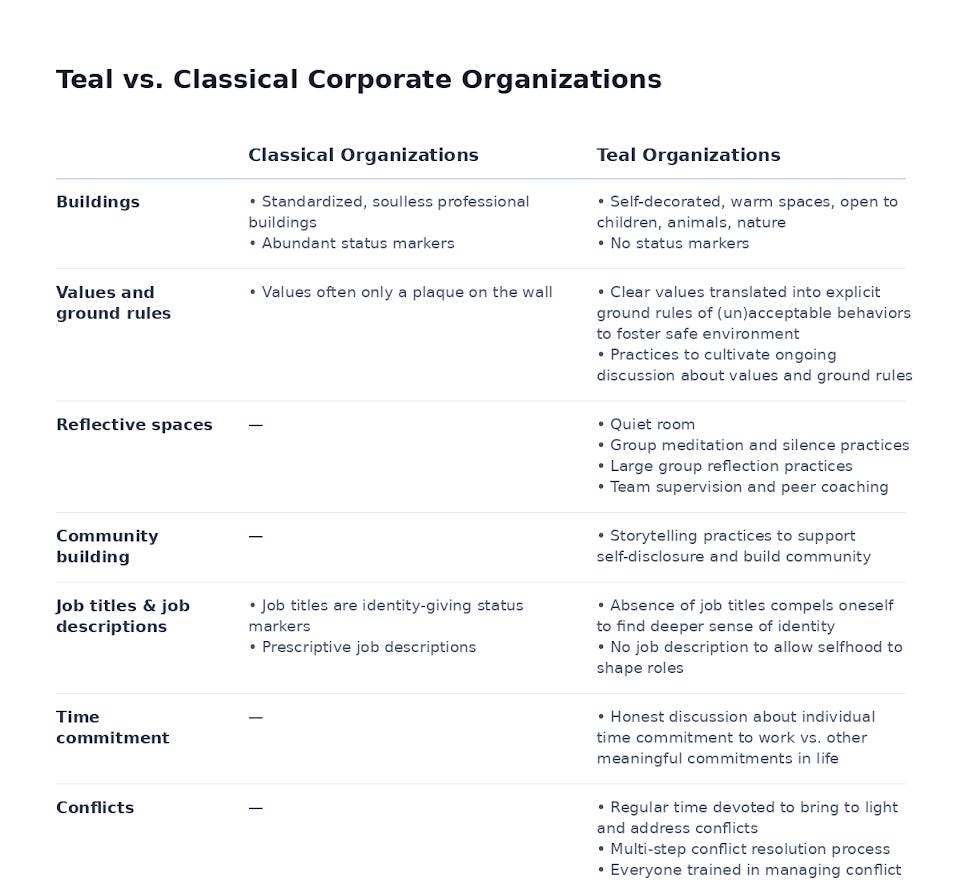
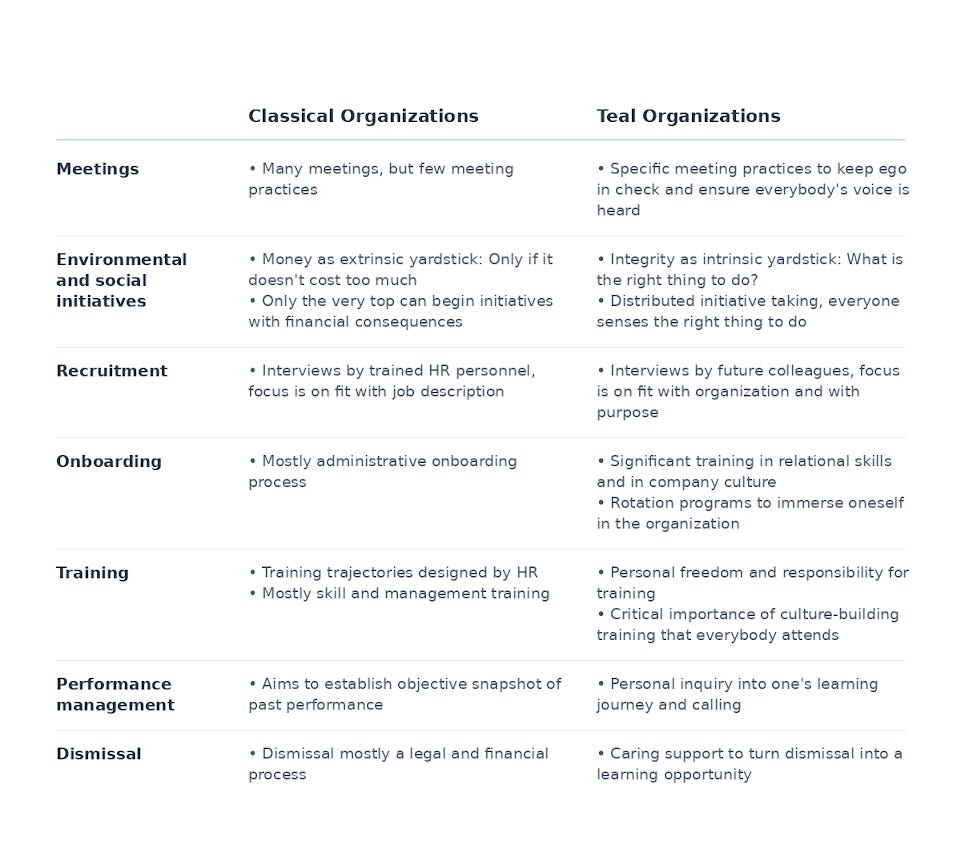
Self-organizing principles solve the problem of dehumanizing power games and can take organizations to a new level of alignment with our deeper human traits. The research by Frederic Laloux, documented in his book Reinventing Organizations, shows that companies can operate effectively through self-managing teams and practices that let people show up as whole human beings. He calls this model Teal organizations.
If I had only one book to recommend to anyone who wants to start or transform a company, it would be Reinventing Organizations.
Weaving it all together
At CosyAI, we need a framework that allows different, autonomous teams to work at their specific pace and mode.
For all of this, we need to make sure that no one’s work is complicated by heavy governance mechanisms. Fortunately, the Teal model provides the exact methodology to achieve this.
The Coop 3.0 model weaves the three foundational layers together into one coherent framework. To complement these basic layers, I picked elements from other organizational models that bring additional value. I tried to do this as ideology-free as possible; what counts is the outcome of an organization that allows humans to thrive and achieve the purpose they really aim for.
In particular, the Coop 3.0 model integrates additional elements from DAOs (Decentralized Autonomous Organizations, which offer tools for transparent governance and resource allocation at scale) and the inspiring DisCOs (Distributed Cooperative Organizations, which bring powerful concepts like Open Value Accounting, feminist economics, and commons-oriented coordination).
The traditional cooperative model establishes democratic ownership. Coop 2.0 adds corruption-resilient design. Coop 3.0 adds the human dimension: the organizational conditions for people to cooperate sincerely, building on the concept of Teal organizations.
Crucially, a Coop 3.0 is a learning organization that is open to adopting new concepts and practices along the way and adapting to new technologies and social conditions. Always under the premise of preserving and promoting the organization’s real purpose.
The challenge of self-organization
Frederic Laloux observed in his research that well-managed, purpose-driven self-organized companies can indeed be very successful. He identified the specific practices and organizational designs that make such companies superior to classical corporations both as workplaces and in terms of achieving their purpose.
But Laloux also identified two make-or-break conditions that determine whether self-organizing companies are likely to survive: the CEO must hold the space for the model, and the board must understand and embrace it. If either fails, the organization faces a great risk of regressing to old command-and-control the moment a crisis hits.
This is a real vulnerability. It means that self-organizing companies, as Laloux describes them, are ultimately dependent on the right people being in charge. The Coop 3.0 model aims to address this by baking the conditions for self-organization into the ownership and governance structure itself. Cooperative ownership means no external investors can panic and override the model. Anti-corruption mechanisms prevent internal power concentration. And this is complemented by specific practices that actively support the people within the organization in developing the inner grounding that enables sincere cooperation.
The seven pillars of Coop 3.0
The Coop 3.0 model rests on seven pillars. The first five create the structural foundation. The sixth is the human heart of the model. The seventh extends it into the age of AI.
Pillar 1. Cooperative ownership
The cooperative model solves, by design, two of the most destructive features of traditional corporations: the compulsion to grow endlessly and the concentration of power in the hands of a few.
For CosyAI, this is the foundation that makes everything else possible. We are building an ecosystem organization that aims for global scale and impact, connecting a diversity of partner organizations, SMEs, developers, and communities into one coordinated vehicle. The cooperative framework is what allows them to actually trust it. Data-pooling becomes possible, even for sensitive data, because the members control the very organization that manages it. Infrastructure investments can be shared because no single investor can capture the returns. Partner organizations can preserve their own identity and business model while participating in collective strategy, because the governance structure guarantees that no one can accumulate disproportionate power.
At the same time, a large part of CosyAI’s value will be collective fundraising for coherent, integrated product strategies. Instead of every member company buying and setting up their own local server infrastructure, CosyAI will bulk purchase GPUs and other hardware and offer a one-click setup at much lower cost. And members can trust CosyAI over big tech cloud providers because they own it. The cooperative model has a proven track record as a vehicle for pooling purchasing power and providing better services collectively.
Cooperative, efficient governance
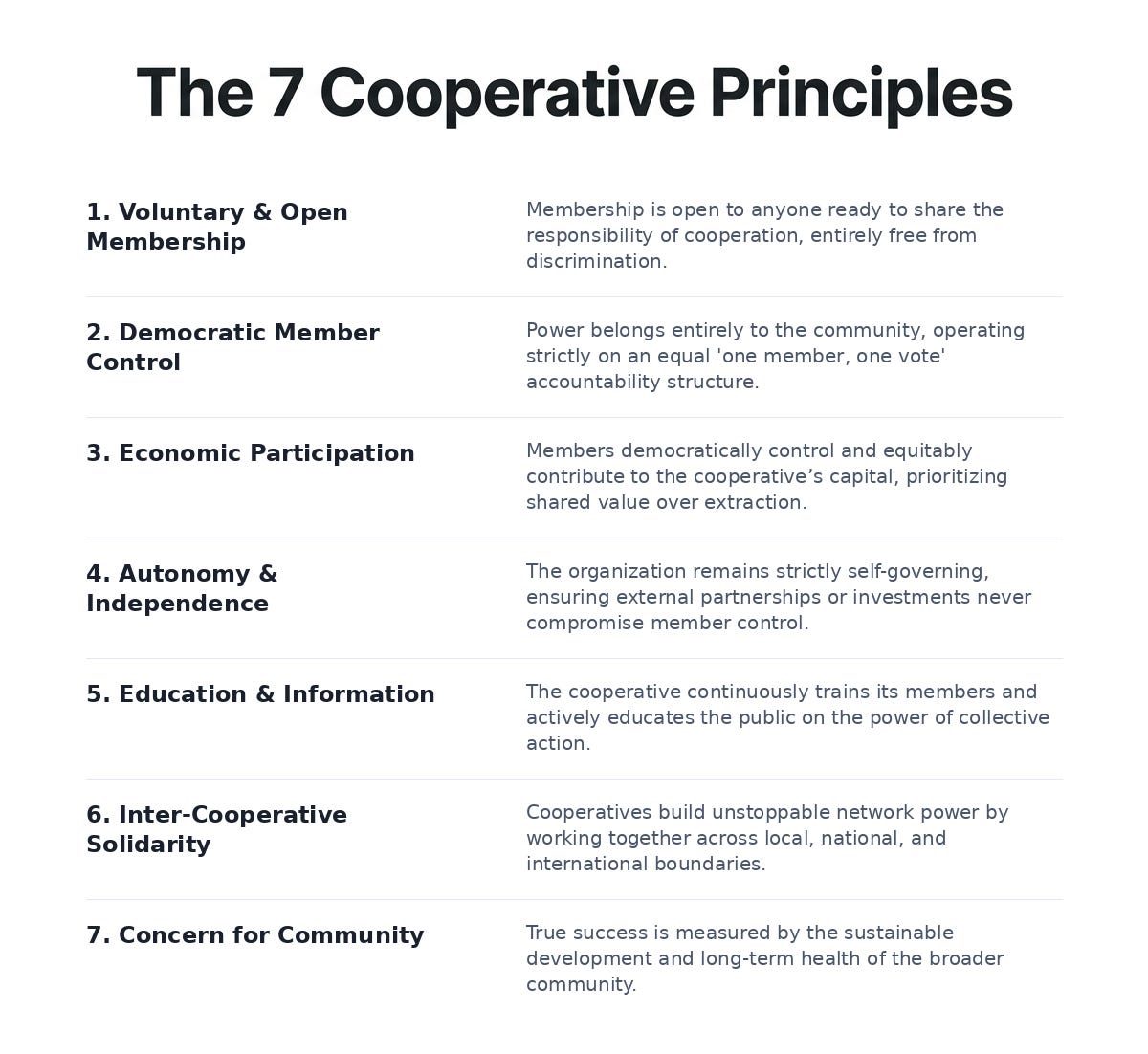
In a cooperative, every member has one vote in the general assembly, regardless of how much they invest. Nobody can buy control.
Contrary to a widespread misconception, cooperatives are accountability models, not management models. Daily operations, product development, prioritization, and business strategy can be handled by specialized teams with full autonomy. In fact, many successful cooperatives have professional management structures that resemble classical startups. The difference is that management is accountable to a broad base of members, not to a handful of majority investors chasing returns.
Generally, cooperatives comply with the seven cooperative principles.
Open to all
A Coop 3.0 is a multi-stakeholder cooperative: membership is open to anyone who feels affected by the company’s activities. Workers, users, partner organizations, neighboring communities. This ensures accountability to all people who have a stake in what the company does, not just to those with a financial interest.
Shares are kept affordable to keep the threshold low. The company can grow its membership for as long as it makes sense, but it is never desperate for growth. This way, it can focus on what actually matters: creating real value for the people it serves.
To protect shared assets from extractive use, a Coop 3.0 can adopt Copyfair licensing, which allows cooperatives and solidarity-based collectives to freely use and build on productive works, while restricting exploitation by profit-maximizing corporations.
The greatest advantage: aligned financial incentives
The most important element of the cooperative model is a simple legal feature: The price of a share is fixed in the bylaws. This single provision eliminates the entire machinery of financial speculation, hostile takeovers, and the relentless pressure to inflate shareholder value at any cost. When a company is successful, more members join and buy shares at the fixed price. Members can cancel their shares and get their investment back. Since the only return on investment is the dividend on the shares, there’s a clear incentive to balance dividend and risk. In high-risk ventures, new members will only join if the expected dividend is high enough. Low-risk cooperatives will attract more member shares at a lower dividend.
This way, no one has an incentive to push for growth purely for the sake of growth. Rather, if the company grows, it means that it is actually providing value at efficient costs, resulting in a dividend that outweighs the risk. In turn, more members join and the company can expand. Once the market is saturated, this process ends, and the company can happily continue at its current scale.
The startup challenge
The old corporate model does have an advantage: it’s an ideal vehicle for collecting upfront investment before the company actually becomes profitable. This is particularly important in investment-heavy fields like AI.
In reality, the old corporate model over-delivers on this promise, turning the company into a capital accumulation machine where the purpose of actually providing value loses importance and the game is increasingly about externalizing costs to society and avoiding competition by chasing “unfair advantages”. I described the flawed structural incentives in more detail in The Corporate Logic.
We can see the misaligned incentives at play in the big tech arms race for AI dominance. The big tech players push each other into crossing self-set safety boundaries and use their capital power to undermine democratic regulation and accountability.
Raising enough investment with alternative models
For CosyAI, we need to find a way to raise enough resources to face big tech at eye level, while preserving the cooperative principles. We do so by using a transparent system that rewards early commitment. It compensates members who invest early and carry more risk, even when dividends are only expected further down the road.
Rather than launching another crypto token, we achieve this through transparent legal provisions built directly into the cooperative statutes. This creates a mechanism that is clear, verifiable, and easy for anyone to check so they can make grounded decisions about whether and when to invest.
It’s crucial that this system doesn’t slip back into the same old corporate compulsion for perpetual growth. It also avoids the dynamics of the financial markets, where investment increasingly detaches from actual economic value and degenerates into speculation games.
Aiming high
To showcase that raising substantial amounts of startup capital is possible even with a truly value-driven cooperative company, I’m proposing the world’s first “1-billion-dollar crowd-investing campaign” for CosyAI.
The idea that many people can combine small contributions to achieve a massive goal is not new. In the 1880s, after France donated the Statue of Liberty to the United States, the American committee fell short of the funds needed for actually setting up the statue on a pedestal. The money to complete the monument was then raised through a fundraising campaign that collected many small donations from more than 100,000 people. It’s a beautiful story of how people got together to contribute to a common symbol of freedom.
This time, it’s not just New Yorkers and Americans who need to join up for a common cause. We need people from all around the world to join together to bring vital economic infrastructure into common ownership to protect our freedom from big tech’s power games.
For this, we need to raise even greater amounts, and that requires offering supporters a substantial return on their investment, in particular given the risks involved in such an endeavor. By doing this in a step-by-step strategy, rather than aiming for a moonshot directly, we reduce the individual risk at every stage. By using a transparent system that rewards early investments and contributions, we can make this possible without falling back to the old corporate logic.
Pillar 2. Corruption-resilient design
Even the best ownership model can be undermined if the organization lacks safeguards against the accumulation of power. The principles of anti-corruption, originally developed for fighting corruption in governments and public institutions, can be applied to any organization: transparency, accountability, and integrity.
For CosyAI, this is existential. An organization that manages AI infrastructure and pools data from thousands of members holds enormous power. The more it grows, the more that power increases. Members need to trust CosyAI with their data, their infrastructure dependencies, and their strategic interests. That trust must be backed by structural guarantees, not just good intentions.
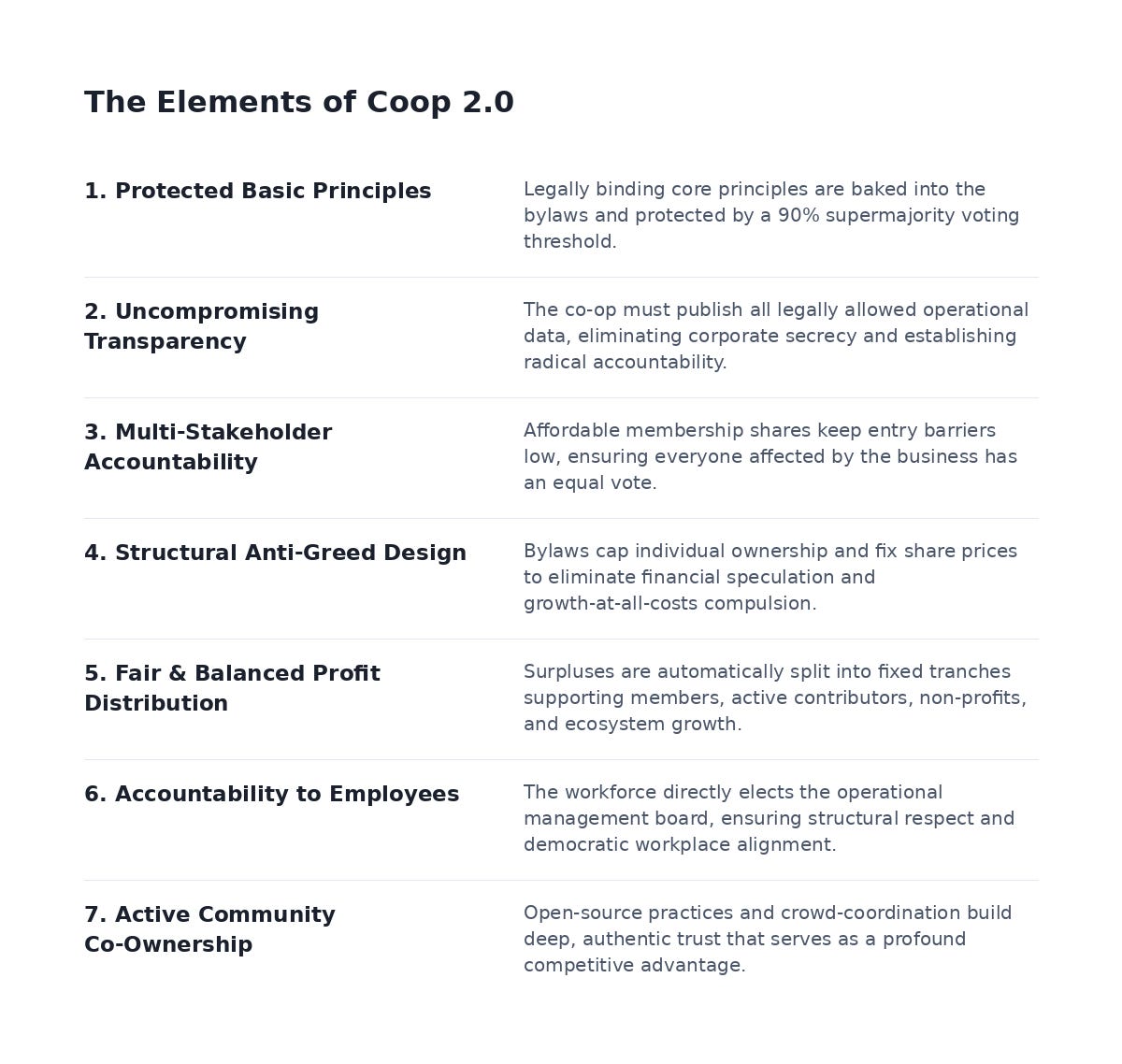
Transparency means that any information that can be published legally and without harming privacy must be published. This includes finances, decision-making processes, and the rationale behind strategic choices. When everything is visible, it becomes much harder to quietly serve private interests.
Accountability means that everyone in the organization can be held accountable if they deviate from the common purpose. Management is elected by employees. Clear basic principles are protected by the bylaws and can only be changed with a 90% supermajority. Any member can initiate accountability processes, and 10% of members can call a general assembly at any time.
Integrity means designing the organization so that it is structurally uninteresting to people driven by greed. Maximum salary ratios, caps on individual shareholdings, and a fair, pre-defined distribution of surplus to members, contributors, social causes, and the creation of further cooperatives. If there is nothing disproportionate to gain, the incentive to corrupt is removed at the root.
Laloux’s research on Teal organizations reinforces these principles. Some use peer-based salary setting, others cap the ratio between highest and lowest pay (one organization limits it to 14:1), and most avoid individual bonuses entirely, since extrinsic incentives distract from inner motivation and breed perverse competition.
These principles were developed and tested in practice with the founding of Fairmondo, which I described in detail in the article on Coop 2.0.
Pillar 3. Self-organizing teams
Frederic Laloux’s groundbreaking research on Teal organizations provides the methodology that turns the Coop 3.0 from a governance model into a living organization.
For CosyAI, this is what makes the vision workable at all. We need dozens of autonomous teams working on different things, at different paces, with different expertise, while still serving a common purpose. One team builds GPU infrastructure. Other teams do foundational research on “cosy” AI models. A third develops privacy-preserving AI tools. A fourth designs the user experience for data-sovereign chatbots.
These teams need real autonomy to do their best work. The focus needed for deep, top-end work is preserved in these teams. At the same time, the organization allows teams to share process innovation and tools, resources, and challenges that outgrow a team’s capacities. And the Teal model allows anyone to reach out and contribute to another team, when they have a relevant idea. Teams are trusted to draw their own boundaries, while inter-team coaches facilitate cooperation and exchange.
Eventually, CosyAI aims to evolve into a top-level AI research lab that attracts the best researchers worldwide. For that, we need to offer something that no corporate lab can: genuine freedom to pursue meaningful work, unprecedented flexibility, and the knowledge that your contributions serve a purpose you believe in.
The Teal model makes this possible. Laloux studied organizations around the world that operate without traditional management hierarchies and found something remarkable: they were not just more humane workplaces; they consistently outperformed their conventional competitors.
What makes Teal organizations different is not just a set of management techniques. Laloux connects them to a broader arc of human development. Just as individuals can grow toward more integrated, less fear-driven ways of being, so can organizations. Teal represents an organizational consciousness where trust replaces control, where purpose replaces strategy, and where people can show up as whole human beings rather than playing professional roles.
Three breakthroughs define this model:
Self-management. Anyone in the organization can make any decision, provided they first seek advice from all affected parties and relevant experts. They don’t need consensus, but they must genuinely listen. At AES, a global energy company studied by Laloux, a financial analyst initiated a major infrastructure project through this process, even though the CEO advised against it. The process trusts people to make good decisions when they are genuinely informed. Conflict is resolved through structured peer processes: first a private conversation, then mediation by a trusted colleague, then a panel if needed.
Wholeness. Teal organizations create environments where people can drop the professional mask and bring their full humanity to work. Meetings start with check-in rounds where people share how they actually feel. Organizations hold regular reflections on topics like dealing with failure. The result is workplaces where people can breathe, where healing happens alongside productive work, and where the chronic stress of performing a role gradually dissolves.
Evolutionary purpose. Instead of top-down strategic planning and sales targets, the organization operates through a “sense and respond” model. The purpose is not imposed by leaders but emerges from the collective. Buurtzorg, a Dutch home-care organization with more than 10,000 employees studied by Laloux, embodies this: its founder openly shares the company’s methods with competitors, reflecting the insight that anyone helping to achieve the shared purpose is an ally, not a threat. This mindset is deeply aligned with the philosophy of sincere cooperation.
At CosyAI, inter-team coaches (enhanced through AI agents) will help maintain coherence across this ecosystem of autonomous teams, ensuring that the shared purpose stays alive without imposing top-down control. Transparent governance mechanisms for allocating shared resources like compute capacity (see pillar 5.) ensure that autonomy doesn’t lead to resource conflicts.
Growth doesn’t need to mean scaling up a single entity. Following the DisCO principle of federation, Coop 3.0 organizations can expand by replicating: small, trusted nodes of around 15 to 20 people that mutualize economic power through lightweight shared protocols. In a Coop 3.0, these nodes connect in an overarching cooperative framework that gives them collective bargaining power and allows for coordinated, strategic action at eye level with global corporations.
One crucial lesson from decades of cooperative and activist experience: declaring an organization “flat” is a recipe for invisible power games. Self-organization requires deliberate structures, clear agreements, and explicit processes. Without them, power concentrates informally and burns out the people who carry the most weight.
Pillar 4. Values-based coordination
In most organizations, only one type of work counts: the work that generates revenue. Everything else, the mentoring, the emotional labor, the community building, the unglamorous administrative tasks that keep the whole operation running, remains invisible. The people who care the most carry the heaviest unseen load, while the system rewards those who optimize for measurable output.
For CosyAI, this challenge takes on a global dimension. We are building a coalition that connects contributors from all continents and cultures, with vastly different economic realities and needs. Some partners are established European SMEs. Others are open-source developers in Nairobi contributing code in their free time. Others are community organizers in São Paulo running local AI education workshops. If we only recognize and reward the work that directly generates revenue, we replicate exactly the extractive logic we set out to replace.
The DisCO model (Distributed Cooperative Organization) offers a powerful framework for this. Grounded in feminist economics, DisCO developed an Open Value Accounting system that makes visible what traditional organizations ignore, and ensures that all forms of contribution are recognized and fairly compensated.
A DisCO tracks three distinct value streams:
Livelihood work (the goods and services that generate revenue),
Love work (voluntary contributions to the commons, like open-source code, educational resources, and shared knowledge), and
Care work (the affective and administrative labor that maintains the collective itself, from facilitating meetings to supporting a struggling colleague to handling the thankless tasks everyone relies on).
Revenue is pooled and distributed dynamically. Members who take on more care work receive compensation adjustments from those who take on less. This prevents the pattern where a few people carry the emotional and organizational weight while others focus exclusively on “productive” output.
For CosyAI, this framework feeds into the contributor basic income pool: a share of collective revenue distributed to all human members, recognizing that the value of the cooperative is created by the entire community. The pool recognizes contributions across all three value streams, so the person running AI literacy workshops in a rural cooperative is valued alongside the engineer optimizing model performance.
This system reflects a fundamentally different understanding of what creates value. The goal is to support a culture where people are free to do what the organization actually needs, rather than what looks most impressive on a performance review.
For more on the DisCO model, see disco.coop.
Pillar 5. Transparent digital governance
A Coop 3.0 embraces digital tools to make governance practical at scale. Financial flows should be transparent, decisions traceable, and the rules for allocating resources clear and reliable, not subject to backroom negotiations.
For CosyAI, this is how trust scales beyond personal relationships. When thousands of members across dozens of countries share infrastructure, allocate compute, and distribute revenue, we cannot rely on everyone knowing and trusting everyone else. Digital governance tools create the verifiable transparency that makes trust at scale possible.
The Web3 movement has produced genuinely valuable innovations here, in particular in the development of DAOs (Decentralized Autonomous Organizations). On-chain voting can create tamper-proof records of decisions. Smart contracts can automate agreed-upon rules, for example distributing surplus exactly as the bylaws define it, or allocating compute according to collectively agreed criteria. Multi-signature requirements prevent any single person from moving shared funds without collective approval.
CosyAI can use these tools wherever they make governance smoother and accountability more reliable. Budgets can be distributed automatically, fund movements verified against the rules, and decisions logged so no one can quietly alter them. Contributor tokens can recognize the work of members who contribute code, product development, or community building. And tools like Circles could automate payouts from the contributor basic income pool.
Avoiding speculation, hype, and ideology
The wider blockchain and crypto space has a reputation for speculation and hype, and that reputation is partly deserved. But many people in Web3 are driven by genuine intentions: building tools for transparency, democratic governance, and community ownership. It’s important to stay non-judgmental when choosing elements for the Coop 3.0 model. We choose tools for their effectiveness and value-aligned outcomes, rather than for ideological reasons.
The DAO movement has sometimes aspired to a “trustless” approach, where automated smart contracts replace human judgment entirely. Coop 3.0 takes a different path. The goal is to promote, protect, and serve human trust, rather than to circumvent it. Transparency and accountability are means for enabling trust, not for removing the need for it. Tools can make it easier to rely on shared processes and see the big picture: budgets can be automated, distributions verified, processes tracked. But the integrity of the organization ultimately comes from the people within it, from real human interaction, and from practices that encourage sincere cooperation (see pillar 6.).
The DisCO model captures this with its concept of a Community Algorithmic Trust: digital tools that facilitate governance but can always be overridden through community deliberation. Humans retain the final word. Technology in service of human trust, never as a substitute for it.
Pillar 6. Designing for sincere cooperation: The Cosy Company
In essence, a Coop 3.0 is a Cosy Company: an organization explicitly designed to support the shift from cooperating instrumentally to cooperating sincerely.
The starting point is a biological fact: our emotional architecture evolved for cooperation. Trust, compassion, and the capacity to care about each other are essential features of the human species. But the conditions of our current societies constantly push us into a latent fear state, leading to chronic defense-mode and competition thinking, and the feeling that we need to look after ourselves first.
This is a core reason why work in cooperative organizations can often feel slow, inefficient, and exhausting. No perfectly designed organizational structures can resolve this, if the people inside the organization remain trapped in the defensive patterns that our societies have imprinted on us. The Cosy practices therefore focus on how we relate to ourselves and to each other.
A Cosy Company creates the conditions for something different: a space where people can gradually reconnect with their sincere core and discover that cooperating from a place of trust and love is not naive, but the most effective and deeply fulfilling way to work. It is a freeing experience. When the pressures of performing, competing, and protecting yourself fall away, an enormous amount of energy becomes available for the actual work and for genuine human connection.
CosyAI aims both to be a Cosy Company and to use AI to make these practices accessible to every member and partner organization, regardless of their size, location, or resources. Every contributor to CosyAI, from a founding partner in Berlin to a developer in Lagos to a cooperative in rural India, should have access to coaching, peer support, and practices that help them reconnect with their sincere core.
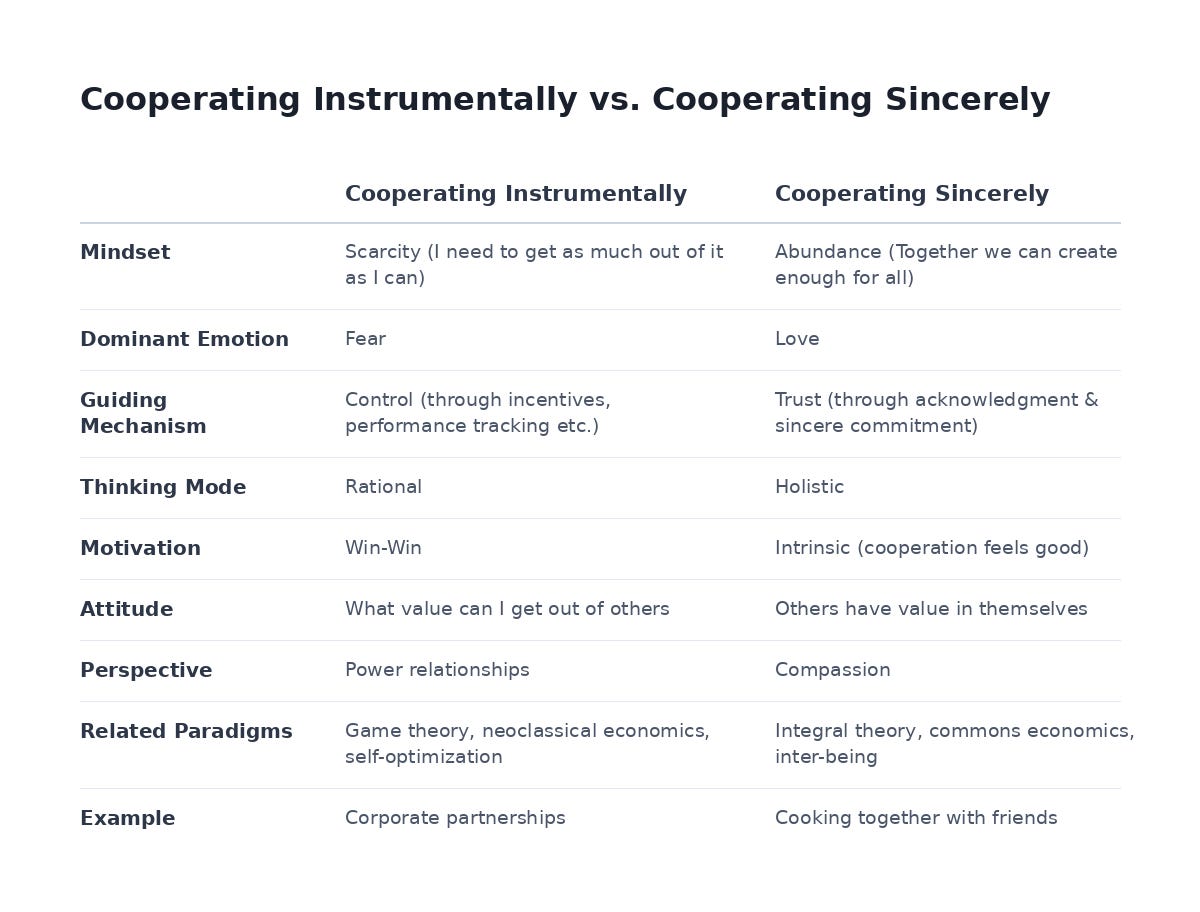
What does this look like in practice?
The Cosy layer builds on the “wholeness” practices documented by Laloux (check-in rounds, peer coaching, group reflections, gratitude practices) and adds specific practices for going deeper:
A common morning metta meditation and a three-minute meditation at the start of every meeting, as deliberate practices for shifting from reactive mode into grounded presence.
An individual sincerity plan for every team member, created in a guided workshop and supported by coaching sessions and peer-to-peer accountability groups. This goes beyond showing up authentically at work. It’s about actively working on the inner walls that keep us from accessing our capacity for sincere connection.
Internal coaches and, for those who need it, access to therapy and deeper support. People find the right team, where they can unfold and develop their individual strengths. Flexible entry paths, including part-time participation and volunteer roles, for people who need a gradual transition.
The Cosy layer is what distinguishes Coop 3.0 from a well-designed cooperative with flat hierarchies. Without it, you have a good structure. With it, you have an organization that actively supports people in becoming who they actually are.
Pillar 7. Embracing AI as an organizational tool
We are living through a moment when artificial intelligence is reshaping every aspect of work and society. The potential is enormous: AI can free us from tedious tasks, help us process complexity that exceeds individual human capacity, and create entirely new possibilities for how we organize and cooperate.
CosyAI will use AI across every dimension of the organization. This makes it even more important to self-host the models, the agentic frameworks, and the data for specialization.
AI agents can be used for accountability and oversight tasks: monitoring governance compliance, tracking financial flows, flagging inconsistencies. This solves the “overview problem” in cooperatives. Members simply don’t have the time and capacities to oversee every decision and activity. But they can define their base values and priorities in a natural language conversation with their personal “participation and accountability agent”. This can also help to prevent governance from becoming political and dominated by the loudest voices with the most free time.
Beyond the organization, AI can help with marketing and member acquisition, and some operational processes. This can help overcome one of the fundamental disadvantages of cooperatives compared to classical companies, since they have less access to speculative growth capital based on “scaling potential”.
In the case of CosyAI, using tools for automating and amplifying outreach is crucial for a coalition that needs to rapidly invite and integrate broad membership, while keeping overhead low. For products and services, AI handles data analysis, process management, and technical work. Humans focus on strategy, R&D, creative work, meaningful cooperation, and the kind of tasks that convey the feeling of building something together.
One rule is non-negotiable: for every AI agent deployment, the AI also creates an educational session for team members to understand the underlying process and first-principle logic behind it. No black boxes. Humans must understand the technical concepts and complexities of what the AI does on their behalf. If the AI develops more complex processes, it ensures that human understanding grows with it. Major insights are released to the public under appropriate open-source licenses. In this sense, a Coop 3.0 is always also a research organization.
At the same time, a Coop 3.0 explicitly protects against the risks of AI: cognitive degeneration through over-reliance, the dehumanizing effects of replacing human connection with machine interaction, and the psychological harms that can come from treating AI systems as companions or emotional substitutes. The Cosy layer exists precisely to keep people grounded in human connection while using AI as a powerful tool.
DisCO captures this well with the analogy of “centaur chess,” where human players pair with AI to achieve results neither could reach alone. Algorithms and machines amplify human talents. They never replace human capacity for ethical judgment, empathy, and nuanced deliberation. The soft stuff is the hard stuff, and no technology can automate it away.
Applying Coop 3.0 at CosyAI
The Coop 3.0 model gives CosyAI a foundation of tested, proven methods for building responsible organizations, and every pillar runs through the vision that follows.
The CosyAI vision unfolds in three phases:
Phase 1: Cooperative AI infrastructure. A platform for hosting local AI models and training specialized models based on our members’ data and needs. This includes building hardware infrastructure with a global network of distributed GPU clusters, and developing a suite of safe AI-based applications developed and governed cooperatively. Part of the revenue flows into a basic income pool for all human members, making the potential of AI to benefit everyone a concrete reality rather than a slogan.
Phase 2: A global network of local cooperatives. Regional multi-stakeholder cooperatives that define and implement AI standards rooted in their own communities. Not distant boardrooms making rules for everyone, but local people deciding how AI should and shouldn’t be part of their lives, connected through a shared cooperative framework.
Phase 3: An AI Safe Space. A framework where people have a real choice about how AI impacts their lives and find protection from unwanted effects. If we collectively decide that certain developments are too risky, we have the organizational structure to advocate for that decision. And even if we can’t stop the broader arms race, we can build the infrastructure to protect those who join from its most harmful consequences.
CosyAI is currently forming a coalition around this shared vision. About 800 people, organizations, and companies have signed up, and we’re in the process of identifying founding partners for registering a European Cooperative Society (SCE), a legal form that allows for global membership under EU data protection standards.
Eventually, CosyAI aims to develop a Cosy framework for recursive self-improvement of AI models: ensuring that as AI systems become more capable, they remain aligned with human values and the cooperative’s purpose, rather than drifting toward optimization goals that serve no one.
This is the stage where things get shaped. If you are the type of person who wants to build something truly different, this is the moment to join.
Why this, why now
The current imbalanced global system creates a pressing need to build true alternatives to the old way of doing business and organizing the economy. At the moment, the window to do that is open wider than ever, since increasingly capable AI enables strategic transformation at a pace and depth that has never been possible before. But the window is narrowing the longer big tech’s centralization of power goes unchecked.
Every month, AI systems reach deeper into our lives. Up to now, the corporate logic has been using these technologies to extend its grip on our societies. It’s doing this at a pace that public institutions cannot match. We cannot regulate our way out of this. The information asymmetries between corporations and democratic institutions translate increasingly into power asymmetries between the corporations and human citizens.
But we have all the ingredients for choosing a different path. Decades of cooperative practice can be taken to new levels of both human grounding and economic effectiveness when combined with proven models for self-organization. All of this can be leveraged by digital tools for transparent governance. And a growing global community of people feels that something fundamental needs to change.
To make this happen, we need to act now. This is why I spend my time putting this Coop 3.0 model into practice. It’s also why I shared the invitation to collaborate on CosyAI as a common platform for building a cooperative approach to AI.
We are all needed
If this resonates with you, please reach out. We’ve been trying to put together concrete options for contributing at different levels:
If you are responsible for an organization, you can join the CosyAI coalition as a founding member.
As an individual, you can become a contributor member and support the creation of CosyAI and other Coop 3.0 pilots.
We don’t need to convince everyone at once. But we do need everyone who clearly feels that this is the right thing to do now.